
What is the Glasgow Coma Scale?
The Glasgow Coma Scale (GCS) is a standardized tool for assessing a patient's level of consciousness. Developed by Graham Teasdale and Bryan Jennett in 1974, it remains the most widely used consciousness scale in emergency medicine, neurosurgery, and critical care worldwide.
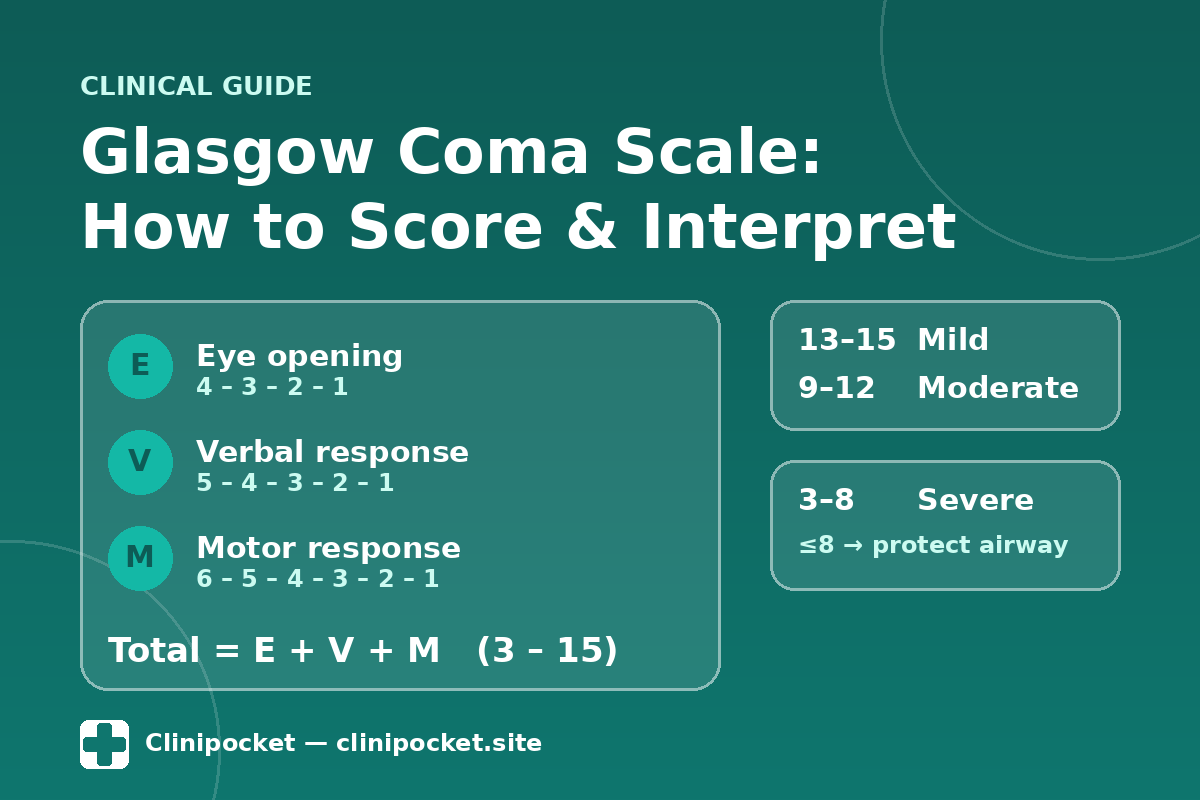
The GCS evaluates three independent responses — eye opening (E), verbal response (V), and best motor response (M) — and sums them into a score from 3 (worst) to 15 (best).
Prefer to calculate it instantly? Use the Clinipocket GCS calculator — it scores, interprets, and explains as you go.
The GCS chart
| Component | Response | Score |
|---|---|---|
| E — Eye opening | Spontaneous | 4 |
| To speech | 3 | |
| To pain | 2 | |
| None | 1 | |
| V — Verbal response | Oriented (person, place, time) | 5 |
| Confused conversation | 4 | |
| Inappropriate words | 3 | |
| Incomprehensible sounds | 2 | |
| None | 1 | |
| M — Motor response | Obeys commands | 6 |
| Localizes pain | 5 | |
| Withdraws from pain (normal flexion) | 4 | |
| Abnormal flexion (decorticate posturing) | 3 | |
| Extension (decerebrate posturing) | 2 | |
| None | 1 |
How to assess each component
Eye opening (E)
- Start with a loud voice — "Can you open your eyes?" If they open to voice, score E3.
- If not, apply a supraorbital pressure or squeeze the trapezius. Opening to pain scores E2.
- Apply pressure to the nailbed — never the fingertip — to avoid confusing simple withdrawal with localization.
Verbal response (V)
- Ask orientation questions: name, location, date/month.
- Full, coherent but disoriented answers = V4; single inappropriate words = V3; moans only = V2.
Motor response (M)
- Give a command first ("squeeze my fingers," "lift two fingers") — obeying = M6.
- If not, apply trapezius squeeze: purposeful movement toward the stimulus = M5 (localizes).
- Nailbed pressure: withdrawal = M4; slow abnormal flexion = M3; extension = M2.
How to interpret the GCS score
| Total score | Severity | Clinical significance |
|---|---|---|
| 13–15 | Mild | Minor brain injury; still monitor — early deterioration is possible |
| 9–12 | Moderate | Significant injury; urgent evaluation and close observation |
| 3–8 | Severe | Coma; consider airway protection — the classic rule is "GCS 8, intubate" |
Worked examples
- E4 V5 M6 = 15: fully alert and oriented.
- E3 V4 M6 = 13: opens eyes to speech, confused, follows commands — mild impairment.
- E2 V2 M5 = 9: opens to pain, moans, localizes painful stimulus — moderate impairment.
- Intubated patient: verbal response is untestable. Modern practice (Teasdale, 2014) is to report the components — e.g., E4 M6 (V: NT) — rather than scoring V as 1 and underestimating the patient.
Common pitfalls (and how to avoid them)
- Inconsistent painful stimuli. Always use the same stimuli (supraorbital pressure, trapezius squeeze, nailbed) so scores are comparable between observers.
- Scoring untestable components as 1. Paralysis, sedation, or intubation doesn't mean "no response." Document NT.
- Reporting only the total. A GCS of 9 means very different things as E3V3M3 vs E2V2M5. Always document the breakdown.
- Assessing motor response in a sedated or paralyzed patient. Wait until drugs wear off, or document NT.
- Forgetting to reassess. The GCS is a trend tool — a falling score (e.g., 15 → 13) matters more than a single number.
GCS in children
Preverbal children can't give a verbal score, so modified pediatric versions (e.g., the Pediatric GCS by Simpson and Reilly) substitute smiling, crying, and appropriate avoidance responses. Verbal scores in young children should be interpreted with developmental stage in mind.
Frequently asked questions
What does a GCS of 3 mean?
It means no eye opening, no verbal response, and no motor response — the minimum possible score. Confirm it isn't due to sedation, paralysis, or airway devices before attributing it to brain injury.
Is GCS 8 really an intubation threshold?
It's a useful rule of thumb, not an absolute. The real concern is airway protection: a patient who can't protect their airway (absent gag/cough, pooling secretions) needs intubation regardless of the exact number.
Can the GCS be used for intubated patients?
Yes — report the components and mark verbal as NT (non-testable), e.g., E4M6-NT, and track the testable components over time.
References
- Teasdale G, Jennett B. Assessment of coma and impaired consciousness: a practical scale. Lancet. 1974;2(7872):81–84.
- Teasdale G, Maas A, Lecky F, et al. The Glasgow Coma Scale at 40 years: standing the test of time. N Engl J Med. 2014;371:2446–2447.
Disclaimer: This article is for education and clinical decision-support only. Always verify scores with institutional protocols and senior clinical judgment.